
Introduction:
As interest in blueberry farming in India continues to grow, many growers are focusing on factors such as climate management, fertigation, cultivar selection, and protected cultivation systems. However, one of the most critical yet often overlooked factors influencing productivity is pollination. Successful pollination directly impacts fruit set, berry size, fruit quality, uniformity, and ultimately farm profitability.
Understanding Pollination in Blueberries
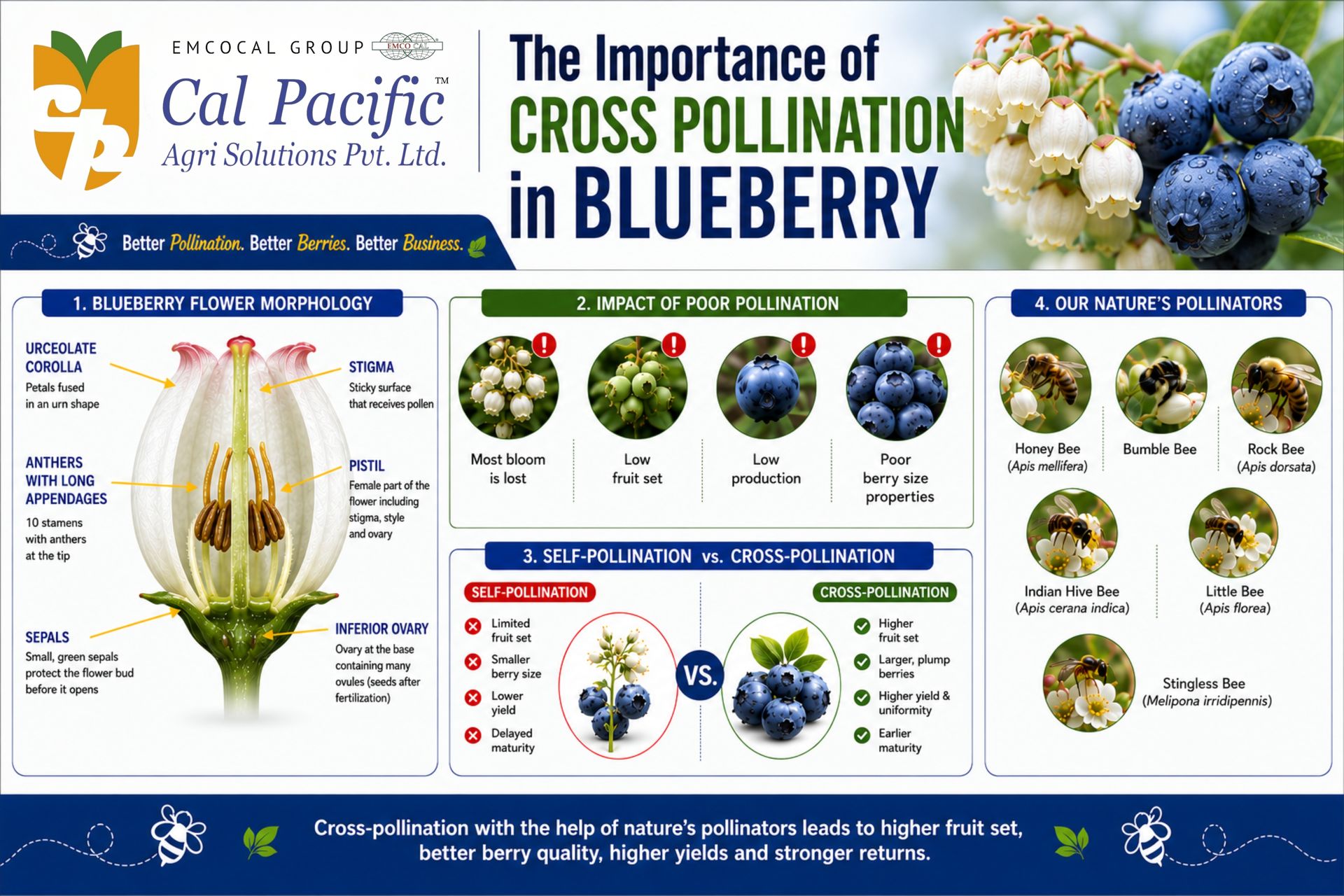
In order to successfully set fruit, blueberry flowers must be adequately pollinated. Pollination occurs when pollen is transferred from the anthers to the stigma of a flower, leading to fertilization and seed development. In blueberries, pollination can occur through either self-pollination or cross-pollination.
Self-pollination occurs when pollen is transferred within the same flower or between flowers of the same cultivar. Since commercial blueberry cultivars are propagated clonally, plants belonging to the same cultivar are genetically identical. Therefore, pollination occurring between plants of the same cultivar is functionally considered self-pollination.
Cross-pollination occurs when pollen is transferred between two different compatible cultivars. Numerous studies have demonstrated that cross-pollination significantly improves blueberry production and fruit quality.
Are Southern Highbush Blueberries Self-Fertile?
Southern Highbush Blueberries are generally considered partially self-fertile, meaning they are capable of producing fruit using their own pollen. However, relying solely on self-pollination rarely delivers optimum commercial results.
Research and commercial production experience have consistently shown that cross-pollination between compatible cultivars leads to:
- Higher fruit set
- Larger berry size
- Increased berry weight
- Earlier ripening
- Improved fruit uniformity
- Higher overall yields
In some studies, cross-pollination has increased berry weight and total yield by as much as 100% compared to self-pollination. Faster ripening also allows fruit to reach the market sooner, improving overall profitability for growers.
Recognizing Symptoms of Poor Pollination
Many blueberry growers observe excellent flowering during bloom but experience disappointing fruit set later in the season. Heavy bloom does not always translate into high yields.
Common symptoms associated with poor pollination include:
- Significant flower drop after bloom
- Low fruit set
- Reduced yield
- Smaller berry size
- Poor fruit uniformity
- Delayed ripening
- Reduced organoleptic quality, including flavour and overall eating experience
While factors such as flower thrips, adverse weather conditions, nutrient imbalances, and other stresses can contribute to poor fruit set, inadequate pollination remains one of the most common causes of production losses in blueberries.
The Role of Pollinators in Blueberry Farming
The unique urn-shaped morphology of blueberry flowers makes efficient pollen transfer highly dependent on insect pollinators. As a result, maintaining strong pollinator activity during bloom is essential for maximizing yield and fruit quality.
Several pollinator species contribute to blueberry production:
- European Honey Bee (Apis mellifera)
- Bumble Bee (Bombus spp.)
- Rock Bee (Apis dorsata)
- Indian Hive Bee (Apis cerana indica)
- Little Bee (Apis florea)
- Stingless Bee (Melipona irridipennis)
These pollinators play a crucial role in transferring pollen between flowers and cultivars, ensuring successful fertilization and optimal fruit development.
Honey Bees versus Bumble Bees
For optimum pollination, blueberries benefit from a combination of honey bees and bumble bees. However, bumble bees are not available in all regions of the world.
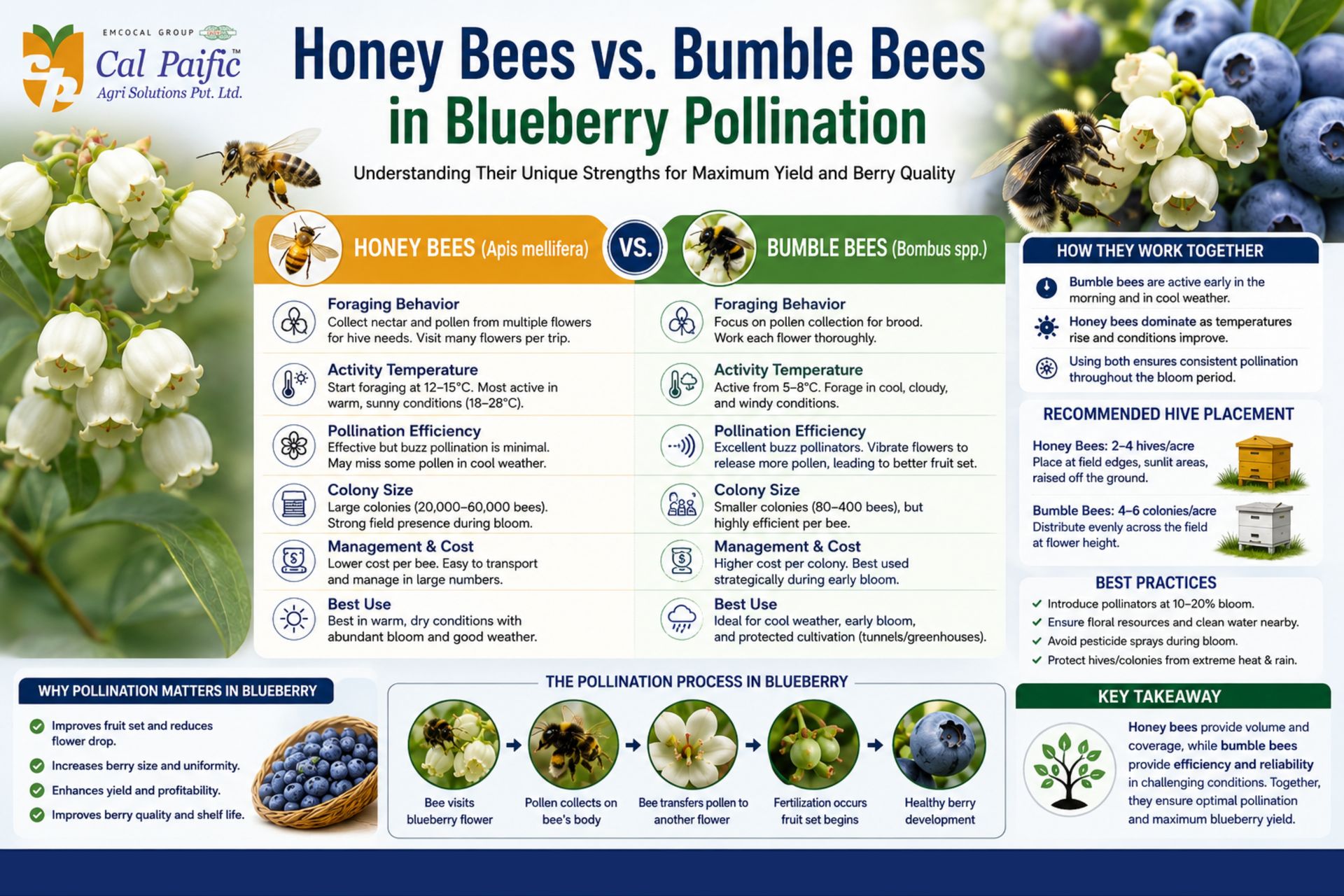
Honey bees are considered delicate pollinators. They enter blueberry flowers during nectar and pollen foraging and contribute significantly to pollen transfer. Although individual honey bees are less efficient blueberry pollinators compared to bumble bees, their large colony populations and high flower visitation rates make them extremely valuable.
Bumble bees, on the other hand, are highly effective blueberry pollinators due to their ability to perform buzz pollination. During foraging, they vibrate the flower, releasing pollen that would otherwise remain trapped within the anthers. In situations where pollen is difficult to access, bumble bees may even create small openings near the base of the flower to reach pollen resources.
Because of their pollination efficiency, bumble bees are often regarded as the ideal blueberry pollinator. Nevertheless, even where bumble bees are absent, strong honey bee activity can still provide highly effective pollination due to the sheer number of foraging individuals present within the field.
Conclusion
Successful blueberry farming depends on more than just climate, irrigation, and nutrition management. Effective pollination is one of the primary drivers of fruit set, berry size, yield, and fruit quality.
Although Southern Highbush Blueberries are partially self-fertile, cross-pollination between compatible cultivars consistently produces superior commercial results. By ensuring adequate pollinator activity and promoting cross-pollination, growers can significantly improve productivity, fruit quality, and profitability.
In modern blueberry production systems, pollination should not be viewed as a natural process alone—it should be considered a critical crop management strategy.
FAQ 1: Are blueberries grown in India?
Answer:
Yes, blueberries are successfully grown in India, particularly in regions with suitable climatic conditions and under protected cultivation systems. Southern Highbush Blueberry varieties are commonly cultivated because they require lower chilling hours compared to traditional northern highbush varieties.
FAQ 3: Do blueberries need cross-pollination?
Answer:
While blueberries can produce fruit through self-pollination, cross-pollination significantly improves fruit set, berry size, uniformity, yield, and earliness of harvest. Commercial blueberry farms often plant multiple compatible cultivars to encourage cross-pollination.