
Introduction
Blueberries are emerging as one of the most profitable farming businesses in 2026 for farmers, agri-investors, and agricultural start-ups. The rising demand from supermarkets, premium retail stores, hotels, cafés, and health-conscious consumers is driving rapid growth in the Indian blueberry market. Earlier, India was largely dependent on imported blueberries, but the availability of high-quality blueberry plants and low-chill or zero-chill blueberry varieties like Cupla c.v suitable for tropical and subtropical regions has made commercial blueberry cultivation in India possible.
With increasing domestic demand, premium market prices, and high return potential, commercial blueberry farming is becoming a preferred choice among progressive growers and investors looking for high-value horticulture opportunities.
Why Blueberry Farming is Emerging in India
Blueberry farming is rapidly emerging in India due to the massive demand–supply gap and premium market pricing of fresh blueberries. India still heavily depends on imports from countries like Chile, Peru, and the United States, importing nearly 3,000 MT of blueberries every year, while domestic production is still limited. Additionally, changing consumer behaviour, evolving snacking habits, and increasing health awareness are further driving the demand for fresh blueberries in India, especially among urban and health-conscious consumers.
Currently, blueberries are sold at premium prices ranging between ₹200–₹300 for a 125 gm punnet on quick-commerce and retail platforms, making blueberry farming one of the most profitable high-value farming opportunities in 2026.
Ideal Climate Conditions for Blueberry Cultivation
Blueberries grow well within a temperature range of 18°C to 28°C, which is considered optimal for their healthy growth and fruit development. Earlier, blueberry cultivation was mainly limited to temperate regions because of the crop’s high chilling requirement. However, with the development of low-chill and zero-chill blueberry varieties such as Cupla cv., Sentinel™, Albus™, and Falcon™, commercial blueberry cultivation is now possible even in tropical and subtropical regions of India.
Blueberries can also perform well in humidity ranges between 50–70%, although humidity requirements may vary depending on the crop growth stage. Adequate sunlight is another important factor for successful cultivation. Highbush blueberries generally require around 7–8 hours of sunlight along with cool to moderate temperatures for optimal growth. Since blueberries are sensitive to extreme heat and high temperatures, maintaining a suitable microclimate becomes essential for better plant health and fruit quality.
The use of high tunnel cultivation systems helps growers overcome climatic adversities and enables the production of high-quality blueberries with uniform fruit size, shape, and better yield consistency.
If you are still unsure whether where blueberries can be grown successfully in your region, Cal Pacific Agri Solutions can help evaluate your farm’s climatic suitability for blueberry cultivation and guide you on the appropriate varieties and corrective measures required for successful commercial production.
Another very important factor that determines the success or failure of blueberry cultivation is the quality of the irrigation water source. Blueberries require good-quality irrigation water with low levels of carbonates, bicarbonates, chlorides, and overall low EC (Electrical Conductivity). Using low-EC water provides growers with greater flexibility to precisely manage fertigation programmes according to the crop’s growth stage and nutrient requirements.
As a general recommendation, bicarbonate levels in irrigation water should ideally be maintained within the range of 35–70 mg/L for optimal blueberry growth and nutrient uptake.
Why Blueberries Require Acidic Growing Media
Blueberries require an acidic growing medium with a pH range of 4.5–5.5 along with good drainage for healthy growth and optimum yield. Maintaining the substrate pH within this range is extremely important because pH directly affects nutrient availability and nutrient uptake by the plant. Blueberries prefer the ammoniacal form of nitrogen over nitrate nitrogen, and fluctuations in substrate pH can significantly influence nutrient balance.
Higher pH levels generally increase the availability of certain macro nutrients but can lead to micronutrient deficiencies, especially iron deficiency. On the other hand, excessively acidic media may improve micronutrient availability but can reduce the availability of major nutrients, ultimately slowing plant growth and development.
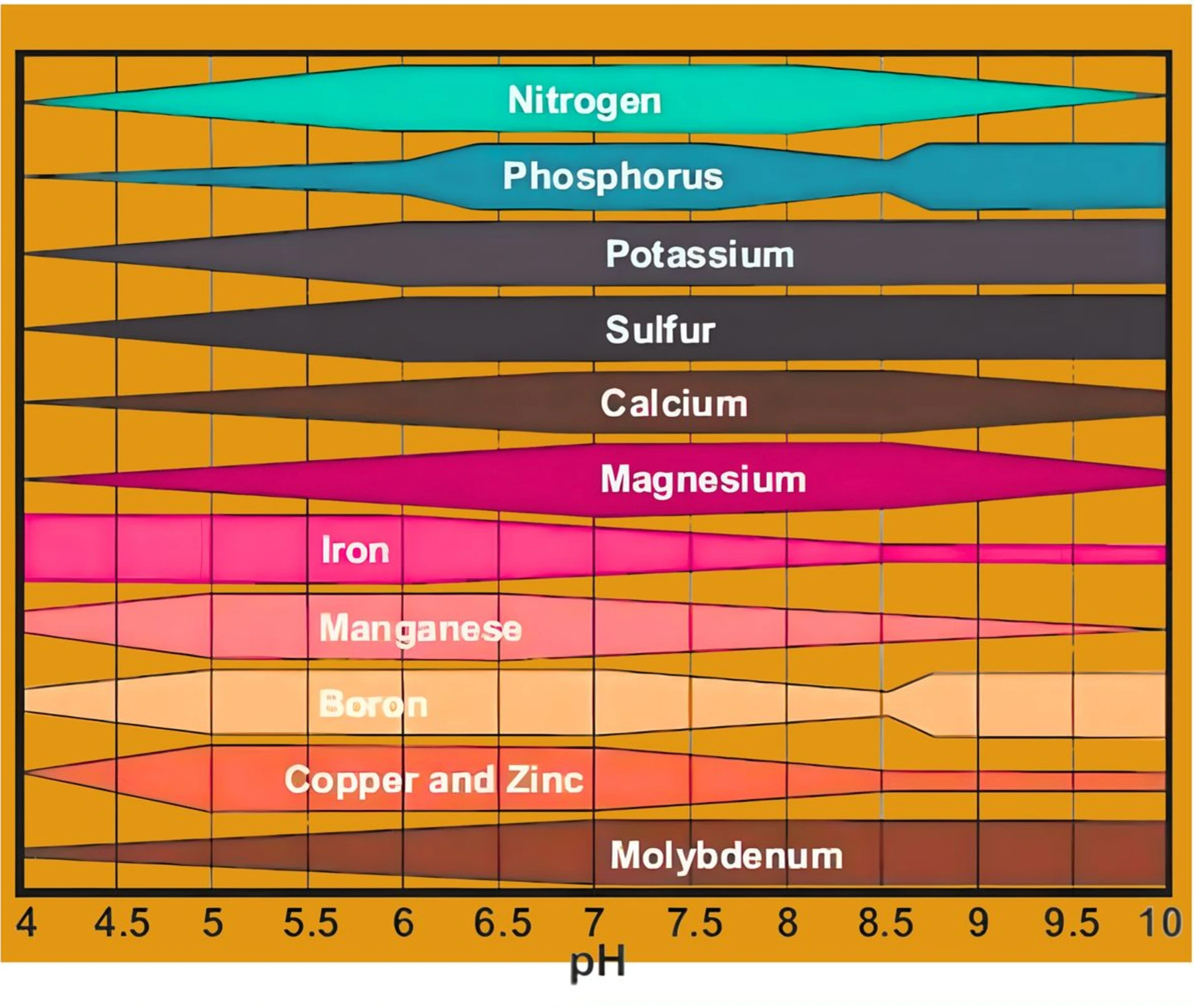
This is one of the key reasons why blueberries are preferably grown in substrate-based cultivation systems rather than directly in soil. Substrate cultivation provides better control over pH, salt concentration, root-zone aeration, and moisture management, which are critical for successful blueberry production.
Additionally, blueberry plants have a very fine and sensitive root system with limited to no root hairs, making them highly susceptible to root stress and poor soil conditions. Because of this, substrate-based cultivation systems are considered more suitable for commercial blueberry farming.
Selection of Blueberry Varieties for India
Selecting the right blueberry variety according to the chilling requirement is one of the most important and critical factors deciding the success of a blueberry farming project.
What is the meaning of chilling requirement?
Chilling hours refer to the cumulative number of hours during winter when temperatures remain at or below approximately 7°C while the plant is in its dormant phase. In blueberries, chill hours are essential for proper flowering, fruit set, and uniform crop development. If the chilling requirement of a variety is not fulfilled, the plant may show poor flowering, uneven growth, and reduced yield.
India predominantly has tropical and subtropical climatic conditions, which makes high-chill blueberry varieties unsuitable for most regions. These varieties require a prolonged period of winter chilling, which is not consistently available in Indian agro-climatic zones, leading to poor flowering, irregular fruiting, and low yield.

Therefore, selecting appropriate low-chill to zero-chill blueberry varieties is extremely important for successful cultivation in India. These varieties are specifically bred to perform under warm climatic conditions and can complete their growth and fruiting cycle with minimal or no chilling requirement. Choosing the right variety ensures better plant establishment, consistent production, and higher commercial viability in Indian conditions.
Therefore, while selecting blueberry varieties, it is very important to choose varieties according to the climatic conditions of the growing region. Along with chilling requirement, growers should also focus on selecting varieties that are true-to-type genetically, highly disease resistant, and commercially accepted in the market. Berry size, firmness, shelf life, and fruit quality are some of the key characteristics that directly influence market pricing and profitability.
This is why licensed blueberry varieties are generally preferred for commercial cultivation. Licensed varieties provide assurance of genetic authenticity, uniform plant growth, proven field performance, disease resistance, and commercial market acceptability. These varieties are developed through rigorous breeding and testing programmes to ensure better agricultural traits and suitability for high-value blueberry farming.
Cal Pacific Agri Solutions is an authorized licensee in India for premium blueberry varieties from the University of Florida and Cuna de Platero. The company offers high-quality commercial blueberry varieties such as Cupla cv., Sentinel™, Albus™, and Falcon™, which have demonstrated strong adaptability and performance under Indian climatic conditions.
Infrastructure Required for Blueberry Farming in India
Protected Cultivation Structure
Blueberries in Indian climatic conditions require a protected cultivation environment to regulate temperature, humidity, and rainfall exposure.
A suitable structure includes:
- UV-stabilized polyethylene film covering (200 micron or as per design)
- Insect-proof side and roof netting
- Side and roof ventilation system for air exchange
- Optional shade net integration in high-temperature zones
The main objective of this infrastructure is to maintain a stable microclimate, preventing heat stress and sudden humidity fluctuations that directly affect flowering and fruit set.
Substrate-Based Cultivation System
Blueberries do not perform well in most Indian soils due to alkaline pH conditions. Therefore, commercial cultivation relies on a fully soilless substrate system.
- Individual grow bags (30 L capacity)
- Substrate mix composed of:
- cocopeat
- perlite
- coco chips
- peat moss
Fertigation System
Blueberries demand precise nutrient management, which cannot be achieved through traditional soil fertilization.
A commercial fertigation setup includes:
- Fertigation injector (Venturi / automated system)
- Separate nutrient tanks (A & B stock solution tanks)
- pH and EC monitoring system
- Acid dosing unit for pH correction
- Mixing and calibration tanks
Irrigation System
Blueberries require frequent but low-volume irrigation, making drip irrigation essential for commercial success.
- Drip lines with emitters
- 2–4 drippers per plant depending on plant age
- Water storage tank
Apart from this some other components that are utilized includes RO filtration unit , trellising system , post harvest management units like cold storage room etc.
Conclusion
Blueberry farming in India represents a shift toward high-value, technology-driven horticulture, where success depends less on traditional agricultural practices and more on precision-controlled cultivation systems. As consumer demand for premium berries continues to grow in both domestic and export markets, blueberries are emerging as a strong opportunity for progressive farmers and commercial growers.
However, it is important to understand that blueberry cultivation is not a conventional open-field crop. It requires a well-engineered production system, including protected cultivation structures, substrate-based growing media, precise irrigation and fertigation systems, and strict water quality management. Among all factors, maintaining an acidic root-zone environment and stable microclimate conditions plays a decisive role in plant health and yield performance.
Frequently Asked Questions (FAQ)
- How much area is required to start the blueberry farming?
Ans: You can start the blueberry farming with 1 acre .
2. Which is the best variety for blueberry cultivation?
Ans: Cupla c.v is considered as best variety for blueberry cultivation.