
Introduction
Blueberry cultivation in India is rapidly transitioning from niche experimentation to organized, commercial-scale farming. With rising domestic demand, premium pricing, and increasing interest from progressive growers, blueberries are emerging as a high-value horticultural crop. However, the long-term profitability and sustainability of a blueberry project depend heavily on one critical climatic factor-chilling hours.
This article explains what chilling hours are, why they matter, how they influence blueberry physiology, and how Indian farmers can strategically manage them to ensure consistent yields and long-term profitability. If you are looking for the variety selection on your farm, you can contact the Cal Pacific Agri Solution Pvt Ltd for removing the risks associated with the variety selection based on chilling hours and other agronomical factors
What Are Chilling Hours in Blueberry Farming?
Chilling hours refer to the cumulative number of hours during winter when temperatures remain at or below approximately 7°C, while the plant is in its dormant phase. For blueberries, these chill hours are not optional-they are biologically essential.
Blueberries are perennials that enter dormancy during winter. During this phase, the plant requires a specific amount of cold exposure to:
- Break dormancy properly
- Initiate uniform bud break
- Support synchronized flowering and fruit development
- Improved fruit set
Without meeting the optimum chilling hours for high-yield blueberries, plants exhibit irregular growth patterns and compromised reproductive performance. This is why understanding blueberry dormancy and chill hours is fundamental before planting.
How Chilling Hours Affect Blueberry Flowering and Yield?
Chilling hours directly influence the plant’s hormonal balance and carbohydrate mobilization. When the blueberry chill hours requirement is not fulfilled, growers may experience:
- Delayed or uneven flowering
- Reduced number of flowers
- Poor fruit set
- Smaller, misshapen berries
- Extended harvest windows with lower market quality
In short, insufficient chill hours have a direct negative impact on blueberry yield, fruit quality, and marketability. This makes chill hours vs blueberry fruit set a critical consideration for Indian climates.
Chilling Hour Requirements by Blueberry Variety:
Category | Chilling Hours Required | Climate Suitability | Description |
High Chill Varieties (Northern highbush) | Above 800 hours | Cold winters, temperate climates | Require a high number of chilling hours to break dormancy and produce fruit. unsuitable for most Indian regions. |
Medium Chill Varieties. | 400-800 hours | Milder winter climates, transitional zones Require a moderate number of chilling hours. | Suitable for regions with milder winters. |
Low chilling (Southern highbush) | Less than 400 hours | Warmer regions, subtropical, tropical climates | Require a minimal number of chilling hours. Suitable for regions with mild winters. |
Zero Chill Varieties | 0 hours | Subtropical, tropical climates | Do not require any chilling hours. ideal for most Indian agro-climatic zones |
For Indian farmers, especially those operating outside high-altitude or northern temperate belts, zero-chill blueberry varieties are essential for consistent production.
Blueberry Chill Hours for Indian Climates
India has more than 15 distinct agro-climatic zones, each with vastly different winter temperature profiles. In most parts of the country, traditional high-chill blueberry cultivars fail to perform due to insufficient winter cold.
As a result, zero-chill blueberry varieties for tropical climates have become the backbone of successful blueberry cultivation in India. These varieties eliminate the dependency on winter chilling and allow stable flowering and fruiting even under mild winter conditions.
Selecting Blueberry Varieties Based on Chill Hours
Selecting blueberry varieties based on chill hours is not just a technical step-it is a risk management strategy. Poor selection leads to:
- Unpredictable flowering
- Lower yields year after year
- Higher input costs with reduced returns
At Cal Pacific Agri Solutions, we apply our extensive on-ground experience and technical expertise to guide growers through a comprehensive turnkey approach, covering every stage of berry production-from site and variety selection to post-harvest guidance-ensuring farms are designed for long-term performance and profitability; growers seeking expert support for building a successful berry operation can Contact Us to receive tailored guidance from the very first step.
Recommended Low and Zero Chill Blueberry Varieties for India
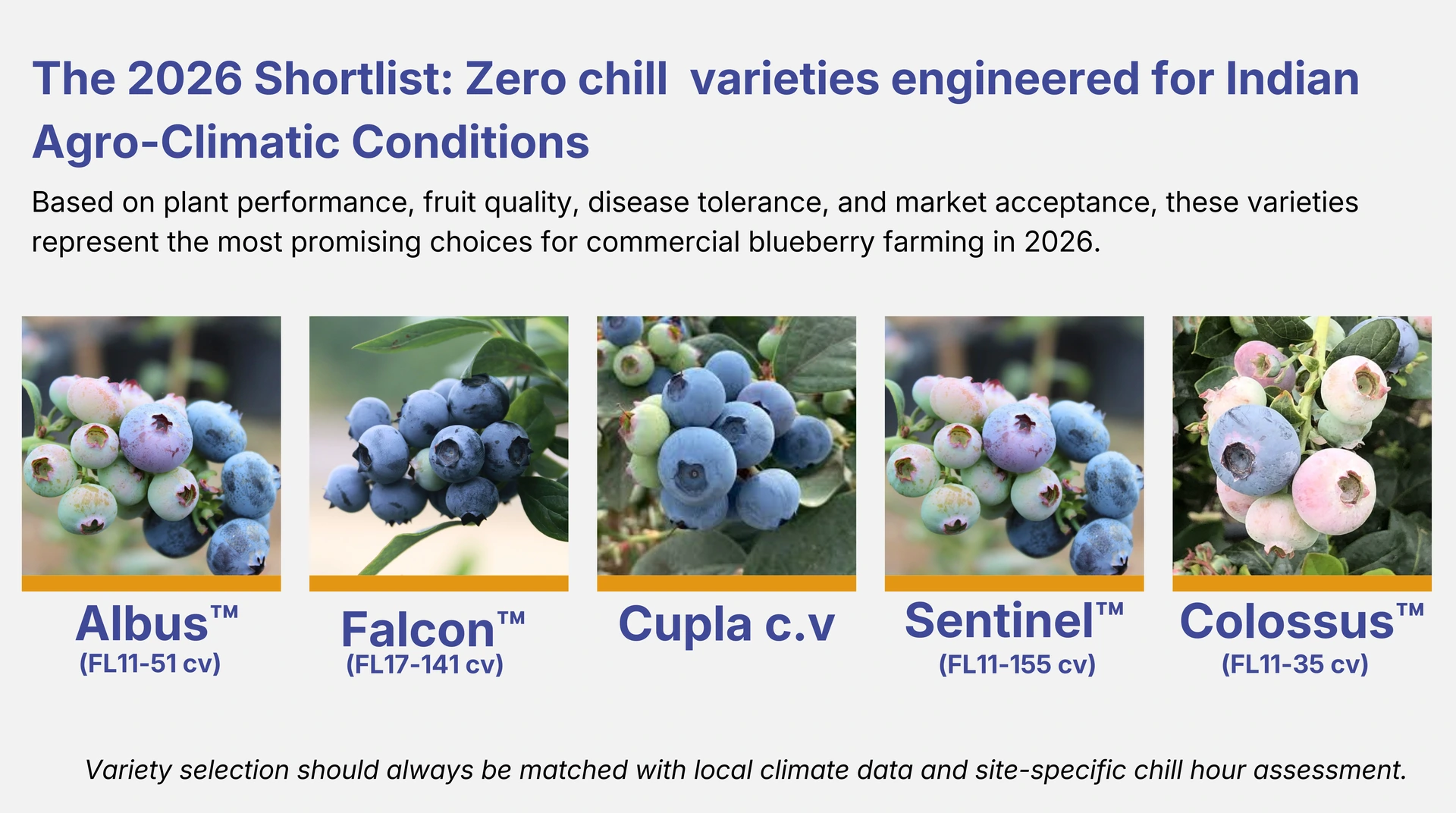
Based on extensive field experience and performance data, Cal Pacific Agri Solutions supports Indian growers with field-tested, low-risk blueberry cultivars, including:
Conclusion
Chilling hours are not just a climatic statistic-they are a biological requirement that governs flowering, yield stability, and farm profitability. Inadequate chilling remains one of the most overlooked yet costly mistakes in blueberry farming.
By understanding how to measure chill hours for blueberry farms, selecting the right cultivar, and aligning farm design with local climate realities, Indian growers can build resilient, high-performing blueberry projects.
Growers looking to reduce risk and implement a turnkey blueberry farming model-from site assessment and variety selection to post-harvest guidance-can Contact Cal Pacific Agri Solutions for expert, on-ground support tailored to Indian conditions.
FAQs
FAQ 1.Which blueberry varieties are best suited for low-chill and zero-chill regions in India?
Answer:
For most Indian regions, low-chill and zero-chill blueberry varieties perform best. Cultivars such as Cupla, Falcon, Albus, Sentinel, and Colossus have shown strong adaptability to Indian conditions, offering consistent flowering, good fruit quality, and stable commercial performance when matched with proper farm management practices.
FAQ 2.Why are zero-chill blueberry varieties important for Indian climates?
Answer:
Most regions of India experience mild winters with very limited natural chilling. Zero-chill blueberry varieties are specifically bred to flower and fruit without requiring winter cold exposure. This makes them highly suitable for Indian agro-climatic conditions, ensuring reliable flowering, stable yields, and consistent fruit quality even in tropical and subtropical regions.